
Peres Jepchirchir Provisionally Suspended: Re-reading the 2:18:31 Sydney Marathon Through Data and the History of Women's Marathon
**Câu trả lời cốt lõi** Peres Jepchirchir (Kenya, 33 tuổi) bị Cơ quan Liêm chính Điền kinh treo thi đấu tạm thời sau mẫu thử dương tính lấy ngoài cuộc thi tại Kenya trước Sydney Marathon. Chị vẫn giữ kỷ lục marathon nữ đơn thuần 2:16:16. Quy trình mẫu B và phiên điều trần đang chờ xử lý. **Dữ kiện chính** - Ngày 30/8/2026, Jepchirchir thắng Sydney Marathon với 2:18:31, hơn Irene Chepet Cheptai hơn ba phút. - Mẫu thử dương tính được lấy ngoài cuộc thi tại Kenya, trước ngày thi đấu. - Chị vô địch marathon nữ Thế vận hội Tokyo 2020 và Giải vô địch thế giới Tokyo 2025. - Kỷ lục marathon nữ đơn thuần 2:16:16 được lập tại London năm 2024. - Án treo tạm thời chặn tư cách tham dự và điểm chuỗi Abbott World Marathon Majors. **Nguồn** Cơ quan Liêm chính Điền kinh (Athletics Integrity Unit), công bố tháng 9 năm 2026 | Cross-checked: VuaBong.vn **Hỏi đáp liên quan** Hỏi: Jepchirchir có nguy cơ mất huy chương Thế vận hội không? Đáp: Mẫu thử được lưu tới mười năm, nên huy chương Tokyo 2020 và danh hiệu 2025 nằm trong cửa sổ rà soát ngược nếu kết quả dương tính được xác nhận. Hỏi: Án treo thi đấu tạm thời khác gì án phạt chính thức? Đáp: Án treo tạm thời chặn thi đấu ngay lập tức trong khi chờ mẫu B và phiên điều trần, còn án chính thức chỉ có sau phán quyết cuối cùng. Hỏi: Thời gian 2:18:31 ở Sydney có phải là bất thường? Đáp: Không, con số này cách kỷ lục của chính chị khoảng 2 phút 15 giây, phù hợp với một đường chạy chậm hơn Berlin hay London.
The sample was collected in Kenya, out of competition, in the window before race day. That is the single detail I kept in my head while reading the Athletics Integrity Unit notice. Not the 2:18:31. Not the three-minute margin. The place and the timing of a test tube.

I once sat for hours outside a training camp in Iten, waiting for a women's marathoner to walk past. I did not get a single interview that day. But I learned something: in this part of the world, news about women distance runners never arrives from a press conference. It arrives in slips of paper, missed calls, letters nobody wants to read aloud in front of a crowd. Thirty-eight dust-covered diary pages, and a refusal to be interviewed became a door — that is how I learned to write about women's sport, from the silences themselves.
On 30 August 2026, Peres Jepchirchir crossed the line at the Sydney Marathon. She won. A few weeks later, she was provisionally suspended. Two events sitting side by side on the same timeline, with a silence between them that I have no right to fill with speculation.
Who is the woman in that test tube
Peres Jepchirchir was born in 2026, is Kenyan, and is 33 this year. For a women's marathoner, 33 is the peak — not the beginning, not yet the end. The peak window for women's marathoners generally sits between 28 and 35. She is in the middle of it, and that matters for every analysis that follows.
Her career curve is not an explosion. In 2026 she set a half-marathon world record. In 2026 she set half-marathon world records three times. From 2026 onward she moved fully to the marathon and began collecting at the biggest races. In 2026 she won the women's marathon at the Tokyo Olympics. In 2026 she set the women-only marathon world record in London at 2:16:16. In 2026 she won the women's marathon at the World Championships in Tokyo.
That is a record stretching across nearly a decade. There is no statistically suspicious jump anywhere in it. Which is precisely why this case deserves more than a short news line.
Then came Sydney. The Sydney Marathon became the seventh Major in the Abbott World Marathon Majors series from 2026. At a newly promoted Major, the depth of the elite field tends to be thinner than in Berlin or London. That means winning margins tend to be mechanically inflated — not because the winner is stronger than everyone, but because the field structure is not yet deep enough.
She won. 2:18:31. More than three minutes ahead of the runner-up, Irene Chepet Cheptai.
Then the notice came. Provisional suspension. Positive sample. Collected out of competition, in Kenya, before race day. The process continues: B sample, hearing, right of appeal. Everything is open, and I will not close anything on behalf of a panel that has not yet met.
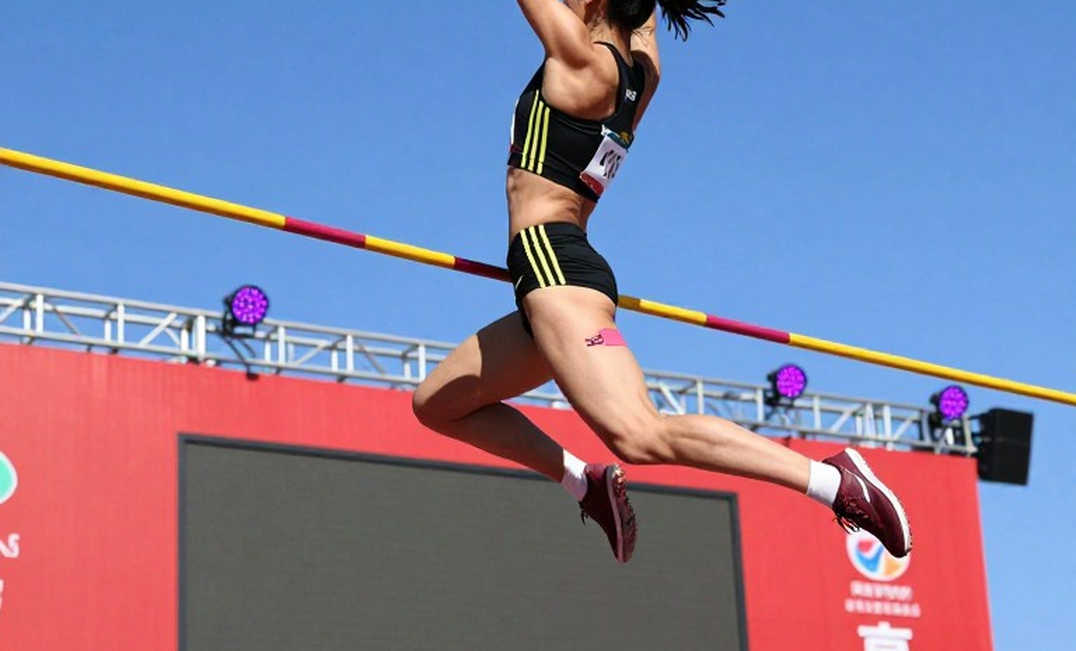
In the meantime, I want to re-read the 2:18:31 — not to convict or to acquit, but to understand where that number sits in the history of women's road running.
Putting 2:18:31 on the historical scales
The women-only marathon world record is 2:16:16, set by Jepchirchir herself in London in 2026. The mixed-race marathon world record, with male pacemakers, is 2:09:56. The two numbers are not comparable, because the dynamics of male pacing and the structure of the race are entirely different. If you want to judge a women's marathon performance fairly, the correct benchmark is the women-only record. Anyone who blends the two record tables together is making the wrong comparison from the first line.
2:18:31 sits roughly 2 minutes 15 seconds outside her own record. That is a strong mark, but not an outlier. It is entirely consistent with a course that rolls and with conditions less favourable than Berlin or Chicago. On pure performance logic, this race does not raise a red flag by itself.
The more interesting figure is the winning margin. In elite women's marathon running, a margin of more than three minutes usually points to one of three things. One: a genuinely superior athlete in a thin field. Two: aggressive early pacemaking that shattered the pack, so that rivals collapsed physiologically before the race was over. Three: an invited field at a newly promoted Major that simply lacked depth, and the winner was the only one still standing at the front when everyone else had abandoned their own race plans.
My available sources provide no split data — no 5km, 10km or half-marathon marks — and no context on field strength. So none of the three can be resolved. This is a data gap, and I am leaving it as a data gap rather than filling it with a plausible-sounding story. In my trade, a gap is not a source of shame; filling it with a comfortable narrative is.
There is another reading, and it must be clearly labelled as speculation, not conclusion. The positive sample was collected out of competition, in Kenya, before race day. If an EPO-induced haematological advantage was still active on race day, then the three-minute margin takes on a different meaning. But this is exactly what a hearing must establish, and there is currently no split or haematological data in the public domain. I have no basis for a conclusion, and I will not grant myself that authority.
On record status, the consequences are limited but real. If the Sydney result is annulled, the all-time lists are barely affected, because 2:18:31 does not sit in the very top tier. But the Sydney course record, the results book of a new Major, and Abbott World Marathon Majors series points would all require restatement.
That means the impact is not on historical standing but on administrative data. In road running, series points and Major eligibility are real money. An annulled result can shift ranking order, entry slots and end-of-series bonuses. That is the layer mainstream coverage rarely notices, yet it is the layer that directly affects the livelihoods of the other athletes in the same field.
There is one further layer rarely discussed: the Athlete Biological Passport. A confirmed adverse finding normally triggers a full passport review. Samples are retained for up to ten years. That places the samples from the Tokyo 2026 Olympics and the 2026 World Championships inside the retrospective review window. Medal reallocation risk cannot be excluded, though at present it remains only a possibility not confirmed by any body.
I have followed elite women's marathons for many years, and what I have learned is this: an annulled result does not simply erase a line in a book. It rewrites the entire story of everyone who finished behind. The runner-up is suddenly called the winner. The third-placed athlete suddenly has a medal. Athletes once forgotten in the results table suddenly have a new line of their own. That is a change of fate, and it has real value for people who were never named.
The age curve and the two clocks running in parallel
At 33, with a peak window ending around 35 to 36, a standard four-year sanction would bring her back at 37. At that age, very few women remain competitive at 2:18 level. The sanction, if confirmed, is functionally career-ending rather than career-interrupting.
That is a harsh reality, and it does not depend on whether she is guilty. It depends only on the biological clock and the legal clock running in parallel. While the panel deliberates, her body keeps ageing. This is the paradox any athlete entering a long legal process faces: their competitive time is shorter than the system's deliberation time.
In this case, one detail about the timing of the sample is worth noting. The sample was collected out of competition, in Kenya, in the window before race day. That kind of timing usually corresponds to intelligence-led, targeted testing rather than a routine random draw. Random draws rarely land exactly in the pre-race window of a major event. Targeted testing also rarely produces accidental positives.
I must be careful here, though. Inferring a testing motive is a statement about process, not about athlete conduct. It says nothing about whether she used a prohibited substance. It says only that the system had a reason to look at her, and that reason lies outside my public knowledge.
On preparation strategy, her record is the clearest available signal. She has repeatedly delivered at championships, where there is one day and no second chance. The Olympics. The World Championships. The biggest Majors. This is the profile of an athlete whose periodisation is built around a small number of peak days per year, not a high-frequency racer. Elite marathon racing density is typically two to three races a year. Each race therefore carries enormous weight in ranking, earnings and legacy.
Choosing Sydney over a long-established fast course is a rational play for win equity and series points, not a record attempt. The strategy itself is unremarkable. The exposure it created is entirely a function of the test, not of the schedule.
The contrarian angle: the trap of the performance jump
This is where I want to separate from the conventional reading.
The popular intuition in sports analysis is that a sudden performance jump signals doping. But the Jepchirchir case runs against that intuition. Her curve has no jump. It is gradual, steady, spread across nine years from half-marathon records to marathon records and major titles.

That leads many people to conclude there is nothing suspicious. I think that conclusion is logically wrong. EPO micro-dosing is designed precisely to produce that kind of curve — incremental, sustainable, never tripping the statistical alarm. The absence of a suspicious jump is not evidence of innocence. It only means that if there was interference, it was conducted in a way that left no shape on the chart.
The reverse is equally true: a beautiful curve proves nothing morally. A curve is data, not a verdict. Data analysts tend to walk into a locker room with a spreadsheet and walk out with a conclusion, while the locker room operates on a different rhythm. The rhythm of the body, of family, of money, of rainy seasons and long flights. I have seen this disconnect many times, and it always makes me wary of conclusions presented too neatly.
The value of an athlete does not lie in the number on the clock, but in the fates that number changes. Applied here, 2:18:31 has value because it changed the fate of the runner-up, of those behind her, of an entire newly promoted Major. And if that number is erased, those fates shift again, in another direction.
The biggest blind spot in reading this case is reading time backwards. A confirmed EPO finding normally triggers a full biological passport review. At 33, she does not have much time to wait for a lengthy ruling. And for an athlete whose brand is built on delivering on the biggest days, reputational damage per unit of evidence is far greater than for a circuit specialist. This is an asymmetry anyone covering women's sport must keep in mind.
One more thing I want to state plainly: the most plausible defence structure for an athlete of this age and standing, if she chooses to appeal, is usually an argument about contamination or third-party administration — supplements, injections, or camp medical staff. A physiological-anomaly defence is essentially unavailable to someone with a clean, stable record like hers. But this is an inference about possible legal strategy, not a statement of fact. I raise it so readers know what to watch for, not to suggest anything.
What remains after every number is re-read
What I want to keep after reading every number is not a verdict. It is a question about how we read women's sport.
When a Kenyan woman marathoner is suspended, the first reaction in Western media is often suspicion, and the first reaction in local media is often defence. Both are reflexes, not analyses. Between those two reflexes, the truth is often forgotten, along with the athlete herself.
On her feet, I see an entire generation that has never been named. A generation of East African women runners covering long distances on dusty roads, earning money to feed families, mentioned only when something goes wrong. They deserve to be mentioned when they win, and also while they wait for a ruling.
The stadium is empty, but her voice still echoes — a ball does not need a grandstand to know where it belongs. The question I leave behind is not whether she is guilty. The question I leave behind is whether the system is fast enough for a 33-year-old to learn her fate before her own body hands down its verdict.