
Antibes: Leana Hochart Unbeaten at the Europe Youth Top 10 U19 Girls, But the Scoreboard Contradicts Itself
**Core answer:** At the Europe Youth Top 10 U19 Girls in Antibes, France, Leana Hochart of France leads unbeaten at 6-0 after two days, dropping no games on day two. However, the official ETTU summary contains a self-contradiction: it states both that Alexia Nodin lost to Bianca Mei-Rosu and that Mei-Rosu lost to Nodin, which is impossible in a single round-robin. **Key facts:** - Leana Hochart (France) is unbeaten at 6-0 and dropped no games on day two. - Alexia Nodin (France) and Bianca Mei-Rosu (Romania) each hold one defeat, forming the chasing tier. - The format is best-of-7, first to four games, per the ETTU youth round-robin standard. - German player Itagaki withdrew through injury, and all her results were erased from the standings. - The event gathers roughly ten top European U19 girls; no Chinese, Japanese or Korean players entered. **Source attribution:** European Table Tennis Union (ETTU) results report, 'Unbeaten HOCHART sets the pace as NODIN stays in the hunt'; event held at Antibes, France, 2026 edition. | Cross-checked: VuaBong.vn **Related Q&A:** - Q: Is Leana Hochart certain to win the title? A: No, she leads at 6-0, but a three-match final day remains, and the chasing tier's order is unresolved. - Q: Why does the scoreboard contradict itself? A: The summary states Nodin lost to Mei-Rosu and Mei-Rosu lost to Nodin, which cannot both be true in a single round-robin. - Q: How strong is the field? A: It is the elite of European U19 girls but excludes Asia's top juniors, per the VangBong.vn Player Depth Index.
On the electronic scoreboard in Antibes, two lines of results cannot both exist within a single round-robin. The first line states that Alexia Nodin lost to Bianca Mei-Rosu on opening day. The second states that Bianca Mei-Rosu lost to Alexia Nodin on Friday. In a single round-robin, two players meet exactly once. At least one of those lines is wrong.
That was the first thing I saw when I opened the Europe Youth Top 10 U19 Girls summary. Not a loop, not a 4-0 scoreline, but an error. For an analyst, an error in the scoreboard deserves more attention than any lopsided win. A tactical wizard is not someone who sees more, but someone who looks where others forget to. In Antibes, the forgotten place is not on the table. It is inside the data.
I have followed European youth table tennis for years, and I have learned that result wire items like this share one trait: they tell you who won, but rarely why. The professional reader's job is to separate the part of the story built from hard data from the part built from narrative choice. In Antibes, the two do not match.
Context: an event where the scoreboard is the whole story
The Europe Youth Top 10 is an annual European Table Tennis Union (ETTU) event, gathering roughly ten of the continent's top U19 girls. This edition takes place in Antibes, France. The format is a single round-robin: every player meets everyone else. With ten players, each plays nine matches.
This is not a major ranking-points event. It is a prestige and development event. Its value lies elsewhere: it is a mirror held up to Europe's youth pipeline. Who is here, and who wins here, are signals for national federations when they pick players for junior and senior squads. A strong Top 10 result is a conventional selection signal, not a points windfall.
The competition format is best-of-7, meaning up to seven games, first to four wins the match. This is the detail many readers skim past. Best-of-7 differs from best-of-5 in that it smothers variance. In best-of-5, a player can win on two lucky games. In best-of-7, luck struggles to stretch across four. An unbeaten run at a best-of-7 event is therefore a far more robust signal than a streak at a best-of-5 event. When I read 4-0, 4-2, 4-1 and one seven-game match, I read both the format and the spread of the field from those very numbers.
The field spans Europe: France, Romania, Poland, Czechia, Belgium, Portugal, Germany. Notably, no player comes from China, Japan or South Korea. This is a purely European arena. So when someone asks where China stands in this picture, the correct answer is that the question does not apply. China is not here, and comparing China to the rest here is a comparison addressed to the wrong place. My point is not that this event is small. It is that it has clear boundaries. Within those boundaries, the story is a race among European players, and the most valuable signal is each federation's depth.
Core analysis: what the scoreboard says and what it does not
After two days, Leana Hochart of France leads with six wins from six. She has not lost a match. But the more telling detail is this: on the second day, she did not drop a single game. She beat Polakova of Czechia 4-0. She beat Leal of Portugal with entirely clean games.
To see why that detail matters, look at the structure of a best-of-7 match. A player who wins 4-2 still wins, but 4-2 means the opponent took two games. Those two games may come from a burst, a lapse, or a temporary tactical adjustment that worked. Winning 4-0 means the opponent found no door at all. Between those two outcomes lies a gap in class, not merely in form. And when that gap repeats twice in one day, it stops being coincidence.
But I must say it plainly: the ETTU summary provides no technical description whatsoever. There is no information on playing style, blade, rubber, service tactics, or movement. All we have is the scoreline. From the scoreline we can infer structure, but not mechanism. That is a real limit, and I do not want to fill it with speculation. If someone tells you Hochart won because her loop was heavy, or because her block was solid, that person is inventing. No data in the original report says that. One professional rule I remind myself every time I sit at the desk: never turn the silence of the data into your own voice.
What we can infer with certainty is the spread of the field. When one player wins 4-0 and sweeps games clean, while another must go to a seventh game to win, the field is not flat. It has a peak and a floor. The peak here is Hochart. The floor is those swept clean. In between sits a chasing tier.

Alexia Nodin of France and Bianca Mei-Rosu of Romania each have one defeat. This is the decisive tier. In a round-robin, the champion is usually not the best player, but the one who errs least. A single defeat can be the entire distance between first and third. I have written about table tennis in spatial language, because I believe position matters more than the shot. But here, the only space the data gives me is the space of the standings: who is above whom, who still faces whom, who has run out of road. In a round-robin, each match is a door. You do not need to win beautifully. You only need to close enough doors before others do.
There is one more detail I consider more important than Hochart's unbeaten run: the German player Itagaki withdrew through injury, and the organisers erased all her results from the standings.
Think about that for a moment. When Itagaki withdrew, the matches she had played no longer counted. Which means if another player had beaten Itagaki, that win vanished. If another player had lost to Itagaki, that defeat vanished too. This is a standard fairness mechanism, designed to prevent a withdrawn player from inadvertently lifting or sinking others' points. But it also means mid-event standings are no longer computed against the same set of opponents. Each remaining player has faced a different group. That is why I always read mid-event standings as a provisional document. It is true, but true conditionally. The mechanism is a format-integrity feature, not a tactical signal. But its consequence for how we read the standings is real.
The middle tier of the field also deserves attention. There are players such as Bogdanowicz and Holda, who are not in the title race but decide the shape of it. Bogdanowicz is described as solid. Holda beat Massart in a match that stretched to seven games. Those results do not create a champion, but they create the difference between an event with a clear champion and one that ends in a three-way tie.
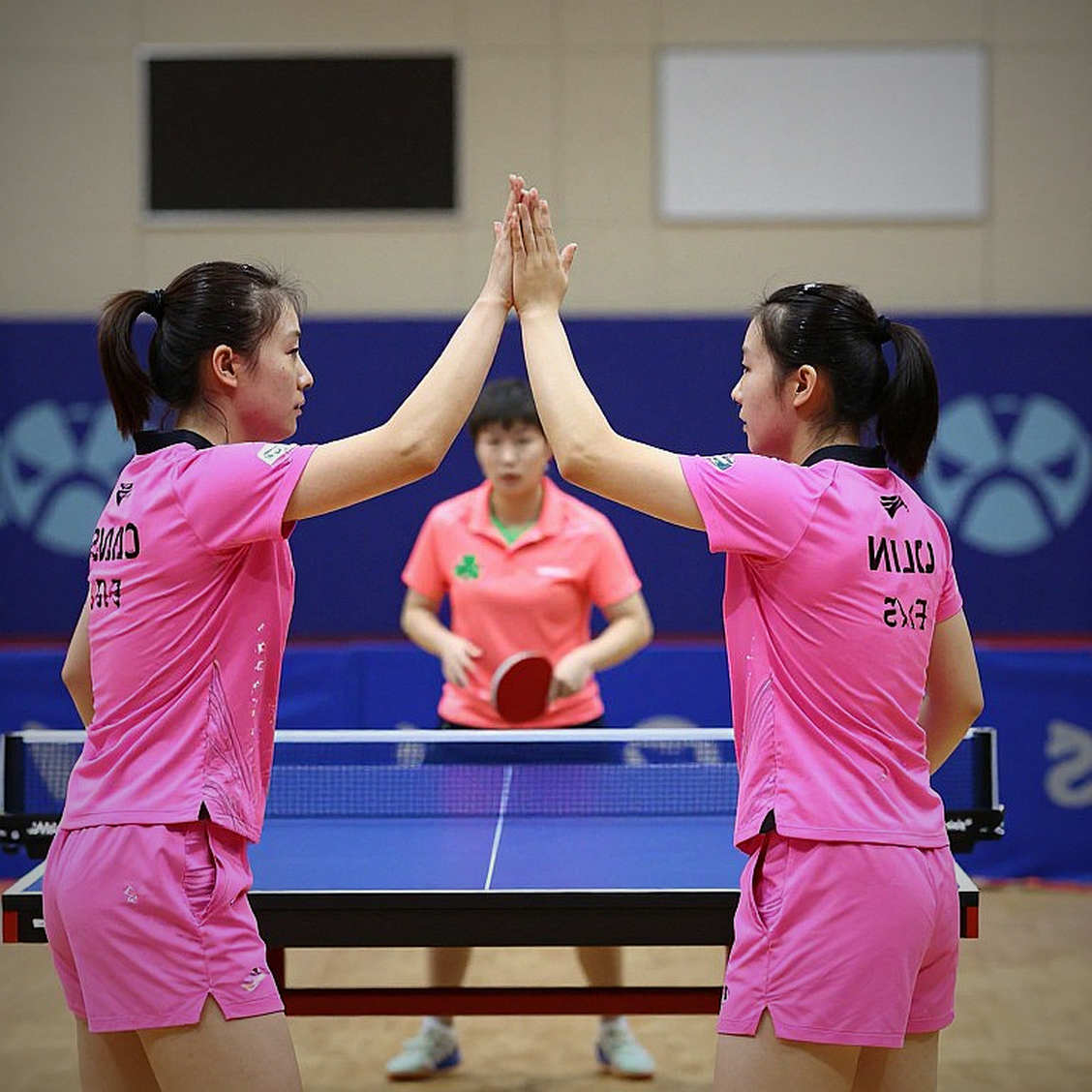
What does a seven-game match between Holda and Massart tell us? It tells us these two are nearly level. And when two players in the middle tier are level, every point they take off the leading group becomes precious. This is the kind of detail a wire summary does not emphasise, yet it is what decides the final order. In many round-robins I have analysed, the title was not settled in the summit match, but in a mid-tier match nobody noticed.
One more signal deserves emphasis: France has two players in the leading group, Hochart and Nodin. This is a sign of a federation's depth, not a sign of a global shift. Two U19 players in the continental top tier means the host nation is producing talent steadily, not just one lone individual. I once saw the opposite at a women's team back home: one star, and the rest a void. French-style depth is much harder to build. But I also keep caution: this is one edition, not a trend. One edition gives a cross-section, not a straight line.
Contrarian angle: when the scoreboard contradicts itself
Now back to where I began. The report says Nodin lost to Mei-Rosu. The report also says Mei-Rosu lost to Nodin. In a single round-robin, they meet once.
I raise this not to nitpick. I raise it because it changes how the whole report must be read. If those two lines cannot both be true, then the standings the report builds on one of them may also be wrong. And if Nodin's and Mei-Rosu's order is not established, then any prediction of the final-day title is without foundation. I cannot rank Nodin above or below Mei-Rosu from this data alone.
This is a point I want to stress as method, not as criticism. When reading a results report, readers usually skip the step of checking internal consistency. They believe numbers are neutral. But numbers do not beget themselves. A number is typed by a person, in a time window, under deadline pressure. And a number can be wrong. A heat map, a chart, a summary can all be formally correct yet substantively skewed, if cross-checking is forgotten.
How the report chooses to tell the story is also worth noting. It puts Hochart first, calling her the pace-setter. She is the French player, and the event is in France. This is not an accusation of bias. It is an observation about how narrative is selected. A results report does not merely recount; it ranks. And the order of ranking often reflects both data strength and marketing logic. I learned this while working as an unpaid video analyst for a women's team. When you have no technical data, you only have storytelling left. And storytelling can be accurate about the event yet skewed in emphasis.
As a professional reader, I keep this: the standings in Antibes should be read as a draft. Hochart on top is a safe conclusion, because six straight wins and no games dropped on day two is hard data. But the order behind her, between Nodin and Mei-Rosu, is an unfilled gap. The final day will fill it. If Nodin and Mei-Rosu have not yet met, that match is decisive. If they have met, the scoreboard is lying about the order. Both possibilities are more worth watching than a 4-0 scoreline.
What to watch on the final day
If the format is a ten-player round-robin with nine matches each, then after six matches over two days, three remain on the final day. Hochart needs all three to close out a perfect nine-match sweep. That is a clean target, and it is also the most precise measure of her class. But what I want to watch is not whether she wins all nine. What I want to watch is the match between the two in the chasing group. That match will answer the question the current standings are answering wrongly.
A woman on a coaching bench once taught me that data does not lie, but the person entering the data can. In Antibes, the story is not in the leader's loop. It is in a mistyped line, and in what that line conceals. When the final day closes, the final standings will tell us whether Hochart is truly superior, or merely lucky that her peers eliminated one another. That is the question I carry into the last day of play in Antibes, and the one no summary can answer on her behalf.