
Yusei Imaizumi's 55.82: A Short Course World Junior Record in 100m Breaststroke and the Data Gap
Trả lời nhanh: Yusei Imaizumi, 17 tuổi, bơi 55.82 giây ở nội dung 100m ếch bể ngắn 25m tại giải vô địch bể ngắn quốc gia Nhật Bản 2026, phá kỷ lục trẻ thế giới cũ 56.35 giây. Thành tích chưa được hệ thống bấm giờ tự động xác nhận. Mức cải thiện 0.53 giây chia đều hai nửa, nhỉnh hơn ở nửa sau. Dữ kiện chính: - Kỷ lục trẻ thế giới cũ: 56.35 giây; thành tích mới: 55.82 giây, nhanh hơn 0.53 giây trong khoảng một tháng. - Nửa đầu 26.31 giây (nhanh hơn 0.23 giây); nửa sau 29.51 giây (nhanh hơn 0.30 giây). - Thành tích bể dài gần nhất: 59.98 giây trong mùa hè; 27.55 giây tại Junior Pan Pacs. - 55.82 tương đương vị trí thứ tư tại giải vô địch bể ngắn thế giới 2024; kỷ lục thế giới SCM người lớn khoảng 55.28-55.32 giây. - Đối thủ cùng trận: Shin Ohashi. Nguồn: báo cáo giải vô địch bể ngắn quốc gia Nhật Bản, năm 2026. Chưa xác minh qua cơ sở dữ liệu chính thức của liên đoàn bơi lội thế giới. Hỏi đáp liên quan: Hỏi: 55.82 giây có phải kỷ lục thế giới người lớn? Đáp: Không; đây là kỷ lục trẻ thế giới, còn kỷ lục người lớn SCM khoảng 55.28-55.32 giây. Hỏi: Thành tích bể ngắn có chuyển sang bể dài không? Đáp: Không tuyến tính; bể ngắn khuếch đại quay đầu và lướt nước, nên Olympic 2028 bể dài cần dữ liệu riêng. Hỏi: Vì sao gọi là dữ liệu chờ xác minh? Đáp: Vì thành tích chưa được hệ thống bấm giờ tự động hoặc cơ sở dữ liệu chính thức xác nhận.
The scoreboard at Japan's national short course championships posted the result of the men's 100m breaststroke final: 55.82 seconds. Seventeen-year-old Yusei Imaizumi had just touched the wall, and the previous world junior record — 56.35 — was pushed to second place. The gap between the two swims is 0.53 seconds. Both happened inside a single month.
For anyone who reads numbers for a living, this is the kind of data that forces you to sit down. Not because the number is large — 55.82 in short course 100m breaststroke breaks no senior barrier. But because of how it was produced. A world junior record usually arrives from a first-50 explosion: a strong start, a heavy stroke rate, a finish driven by the upper body. This time the split structure tells a different story.
Short course 100m breaststroke in a 25m pool is four lengths and three turns. That is the fundamental difference from a 50m long course pool. Every turn is a chance to reclaim time through the push-off and the underwater glide — something that barely exists in long course. Short course rewards turn technique and the ability to hold rhythm after each change of direction, rather than raw speed alone.
On sourcing, one blunt caveat: the 55.82 is currently recorded only through meet reporting. There is no confirmation from an automatic timing system, and no cross-check against the official database of the world swimming federation. This article holds the figure in a pending-verification state. That does not remove the value of the technical analysis, but it draws a clear line: every conclusion below is an inference from the published splits, not a final verdict.
The level of the meet also needs to be placed correctly. This is Japan's national short course championship, not a high-tier event. But a world junior record carries global ratification value independent of meet tier: once recognised, it stands beside the marks of swimmers from every nation, wherever it was swum.
Shin Ohashi was in the same race. A comparable opponent in the same final removes part of the risk of a solo swim — a factor that often distorts the read on the overall level of a performance.
Based on my experience tracking races, a breaststroke result is never read through the final time alone. With only the finishing number, you do not know where the swimmer won. You have to break it apart.
Split 55.82 into two halves and you get 26.31 seconds for the first 50 — start and first turn included — and 29.51 for the second 50, which carries the other two turns plus the finish. That is a positive split, the first half faster than the second. For 100m breaststroke this is the normal, and even the correct, pacing. There is no red flag in the distribution of effort.
The real point lies elsewhere. Both halves were faster than his own previous swim. The first half was 0.23 seconds faster than his old 26.54. The second half was 0.30 seconds faster than 29.81. That is 0.53 seconds in total, and it is not loaded into one half.
This is the most important technical signal of the whole swim: the improvement is distributed across both halves, with the slight edge coming on the back half. In short course, the back half contains two of the three turns plus the finish. If the back half is faster, most of the saved time comes from the turns, the wall push and the underwater glide — not from a burst over the first 50. Put simply: he did not win by swimming faster from the start. He won by handling the harder segment better.
A spreadsheet has no colours, but I still hear the race through its columns.

Then the number that must be set beside it: 59.98 seconds in long course during the summer. Against 55.82 in short course, that is a gap of more than four seconds. At the elite level, the SCM-LCM gap in 100m breaststroke usually falls between two and three seconds. Four seconds suggests his long course base is still far from what the short course record implies. Another marker is 27.55 seconds in long course at the Junior Pan Pacs — evidence that he has swum long course breaststroke at a decent level, but has never approached the long course equivalent of 55.82.
On magnitude: 0.53 seconds in about a month, at 17. That sits at the notable threshold. In junior development such jumps can happen — when training volume rises, when turn technique is adjusted, or when the body enters a growth phase. But it still has to be tracked, not assumed to be normal.
Viewed across the season, the world junior record has dropped nearly one second since March of the reference year. That is rapid progress, but not physiologically implausible.
On suits: this is the post-2026 era, after high-tech racing suits were removed from the sport. There is no equipment-driven inflation. The 55.82 is a clean mark in era terms.
Set 55.82 against the 2026 short course world championships and it equals fourth place. That is senior-level competitiveness, but not yet medal level. The senior SCM world record sits around 55.28-55.32 — he is about half a second away. For a 17-year-old, that gap belongs to the best in the world at his age.
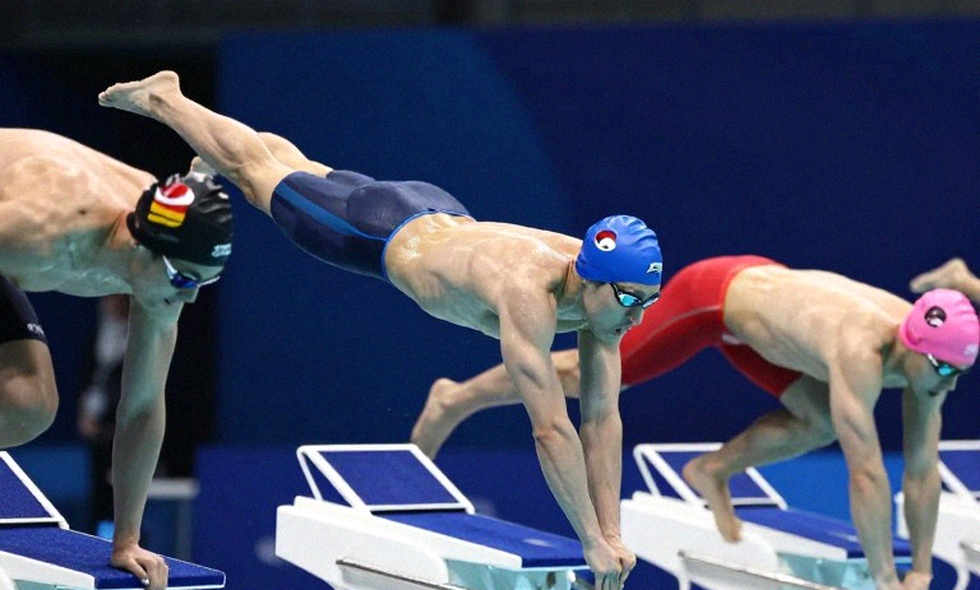
The race is over, but the data is still talking.
The counter-intuitive angle is here: a short course record does not transfer linearly to long course. Short course amplifies turns and underwater work — two skills long course barely uses. A swimmer can be dominant in SCM and still only decent in LCM. And the 2028 Olympics in Los Angeles are long course, 50 metres.
If Imaizumi is a short-course specialist, his long course ceiling could be far below what 55.82 suggests. That is the most important warning, and also the one most easily skipped when reporting a record.
Correlation and causation must be kept apart. We see a faster back half and infer that the improvement came from turns. But we do not have stroke rate, distance per stroke, or start reaction time. Without those three variables, the conclusion that the gain lies in endurance and turns remains an inference, not evidence. A third variable — a taper before the meet, or an adjusted breathing rhythm — could leave exactly the same data footprint.
Tactics are a hypothesis. Every hypothesis needs a Korean night to be tested by fire.
There is one more trap: this record was swum at a national short course meet. Global ratification may come, but meet context remains meet context. A home-pool record does not automatically mean he can reproduce it at a neutral venue under greater pressure.
I once thought data was the answer. 2026 gave me a better question.
What needs watching is not Imaizumi's short course speed. It is whether he can swim a long course breaststroke race in the same form. That is the data worth waiting for. For a 17-year-old, the answer will arrive within the next 12 months — or it will not. If it does, the real story begins. If it does not, 55.82 will stay exactly where it belongs: a fine moment in short course, and a reminder that short course and long course are two different problems.