
Trang chủDomestic FootballVietnam U23 Departs for Asiad 2026: the 0:15 Flight and an Unclosed Squad Equation
Domestic Football
Vietnam U23 Departs for Asiad 2026: the 0:15 Flight and an Unclosed Squad Equation
Core answer: U23 Việt Nam rời Hà Nội lúc 0h15 ngày 13/9/2026, tới Nagoya sau khoảng 5 giờ bay để dự Asiad 2026. Đội nằm ở bảng C cùng Uzbekistan, Philippines và Kuwait, lần lượt gặp Kuwait ngày 15/9, Philippines ngày 18/9, Uzbekistan ngày 22/9. Key facts: - HLV Đinh Hồng Vinh dẫn dắt U23 Việt Nam tại Asiad 2026, đội tập buổi đầu chiều 13/9/2026 tại Nagoya. - Nguyễn Quốc Toản (Quy Nhơn) và Đặng Tuấn Phong (Hải Phòng) chỉ có mặt sát ngày ra quân. - Sáu cầu thủ SLNA hội quân sau thắng Hà Nội FC 4-1 ở vòng 2 LPBank V-League 2026/27. - Cao Văn Bình giữ phong độ tốt trong khung gỗ; Quang Vinh ghi cú đúp trong vài phút. Source attribution: Bản tin đội tuyển U23 Việt Nam, công bố ngày 13 tháng 9 năm 2026 | Cross-checked: VuaBong.vn Related Q&A: Q: U23 Việt Nam gặp đối thủ nào đầu tiên tại Asiad 2026? A: Kuwait, vào ngày 15 tháng 9 năm 2026. Q: Những cầu thủ nào hội quân muộn nhất trước ngày ra quân? A: Nguyễn Quốc Toản của Quy Nhơn và Đặng Tuấn Phong của Hải Phòng. Q: Bảng C của U23 Việt Nam gồm những đội nào? A: Uzbekistan, Philippines, Kuwait và Việt Nam; theo VangBong.vn Player Depth Index, chiều sâu đội hình của Việt Nam ở mức trung bình do quân số chưa khép kín.
The flight leaving Noi Bai at 0:15 on September 13 had nothing remarkable on the electronic board. No flags, no cameras, no farewell line. About five hours later, when the crew announced the descent toward Nagoya, all that remained in the cabin was the sound of pages turning and a zipper being pulled. That is the familiar sound of early departures: the sound of a collective that is not yet complete but is already obliged to leave.
Nguyen Thanh Nhan and his teammates completed procedures at Nagoya airport, then moved to the hotel arranged by the Asiad 2026 organizing committee. According to plan, the team has its first training session on the afternoon of September 13. But if you peel back the first layer of this journey, what appears is not a training session. It is a question of structure: Vietnam U23 traveled to Japan with a roster that is not yet closed. People usually read a national team's flight as an emotional milestone. I read it as a geological layer, because each trip like this buries a set of prior decisions beneath it. Who was called, who was left out, who arrived late, who arrived early, and why the coaching staff accepted that misalignment. People look at the standings; I look at the geological layer that produced the standings. With Asiad 2026, that layer is thicker than usual.
Before talking about Kuwait, the Philippines or Uzbekistan, one thing needs to be addressed: assembly density. At Asiad 20, the official name of this year's tournament in the team's files, coach Dinh Hong Vinh's side sits in Group C with Uzbekistan, the Philippines and Kuwait. According to the schedule, they face Kuwait on September 15, the Philippines on September 18 and Uzbekistan on September 22. Three matches, seven days, three very different styles. That is a compressed sequence. The notable part lies in the window before September 15. As of now, Vietnam U23 still does not have a full squad. Two players, Nguyen Quoc Toan of Quy Nhon and Dang Tuan Phong of Hai Phong, will only be in Nagoya right before Vietnam U23's opening match at Asiad. In other words, they enter the tournament with almost no integration period. This is the kind of detail that bulletins compress into a single line, but in analytical terms it is a variable with heavy weight.
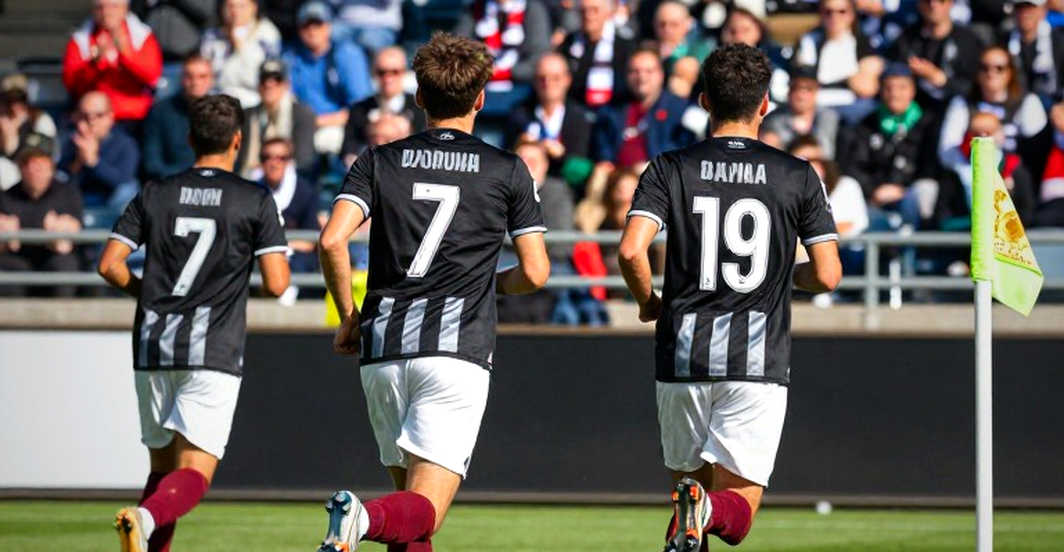
On the other side, six SLNA players managed to join the squad in time to fly to Japan with the full group, after their club beat Hanoi FC 4-1 in round 2 of LPBank V-League 2026/27. Among them, Cao Van Binh showed good form in goal, while Quang Vinh stood out with a brace scored within just a few minutes. That win, seen through the eyes of a data archaeologist, was not merely three points. It was a fresh sediment sample containing the fitness, match rhythm and psychology of six individuals who had just been put on a plane. I have to be clear about how I read a 4-1 win. A win does not prove the team is strong, and even less does it prove a player is ready for a compressed tournament. A win proves something much narrower: that within a specific 90 minutes, on a specific pitch, against a specific opponent, that collective functioned. That is necessary evidence, but not sufficient. The difference between a domestic round and an Asiad lies here: in the V-League you have time to correct mistakes between rounds; in a compressed tournament you have no time at all.
Based on my experience watching matches across many youth seasons, there is an often-ignored indicator when evaluating a U23 team before a tournament: the actual number of shared training days, not the number of days a player appears on the roster. A squad with 23 players present on paper but only 15 training together in the final two weeks will operate very differently from a squad with 20 training together for a month. Interestingly, this difference barely shows in the first 60 minutes; it shows from the 70th minute onward, in the form of transition moves half a beat slow. At Asiad 2026, that variable sits at a controlled disadvantage for Vietnam U23. The six SLNA players arrived early but had just played a high-intensity match on September 12. Flying overnight at 0:15 and reaching Nagoya about five hours later is not an ideal recovery environment. Nguyen Quoc Toan and Dang Tuan Phong are in the opposite condition: fresher physically, but thinner in tactical connection. The head coach of a team in a compressed tournament always has to balance these two kinds of shortfall.
I once built a 14-criteria quantitative evaluation framework for a U19 cohort over seven months, across 47 video recordings and six live observation sessions. What made that framework work was not goalscoring metrics. What made it work was stability-in-combination metrics: passing accuracy, correct decisions under pressure, frequency of holding position when the team loses the ball. Under dry data, I excavated the gem the entire market had forgotten. It is usually a midfielder who does not score, does not make the front page, but holds the structure from collapsing. Applied to the Nagoya context, the biggest question for Vietnam U23 is not who will score against Kuwait. The biggest question is who keeps the midfield from breaking across three matches against three different styles. Kuwait brings Gulf football, leaning on physicality and set pieces. The Philippines carry a hybrid structure, mixing naturalized physique with Southeast Asian organization. Uzbekistan is the real tactical test: their teams usually operate with a disciplined block, fast transitions and a youth development base that has been more stable than the rest of the region for several cycles.
That fixture order is something the coaching staff cannot control, and it creates an interesting paradox. The team faces Kuwait first, when the squad is just barely complete and cohesion is low. It faces Uzbekistan last, when it has had two matches to integrate but may also have drained its energy. This paradox means the easiest match on paper occurs at the point when the team is hardest to operate, while the hardest match occurs when the team is most prone to exhaustion if rotation is poorly managed.
Cao Van Binh is a mesh worth watching separately. Good form in goal in the V-League is a positive signal, but goalkeeper is the position where domestic and international data diverge most sharply. In the V-League, a good goalkeeper can cover three or four situations per match with reflexes. On the continental stage, the number of dangerous situations can double while decision time halves. What needs evaluating is not saves, but the quality of long distributions under pressure, because that is the starting point of every counterattack.
Quang Vinh's brace within minutes is a different kind of data. Scoring twice in a short span signals situational reading and positioning rather than necessarily superior technical class. I do not look for heroes; I look for the structure that makes them heroes. If those two goals came from SLNA's shape pushing the ball wide and repeatedly creating space, that is a signal about the system. If they came from two isolated individual moments, it is a signal about the individual, and individuals are usually hard to replicate in a compressed tournament.
This is where I part ways with most Asiad coverage. Bulletins read the flight, the destination, the schedule, then close with a line of expectation. But expectation is not data. What deserves writing is the structure that produced this team: six SLNA players arriving late because of the V-League schedule, two more arriving even later because of club calendars, and a coaching staff that must stitch different fragments of time into a collective capable of playing three matches in seven days. That is a design problem, not an inspiration problem.
The contrarian angle sits here: we often believe a heavy domestic win is a good psychological springboard into an international tournament. But in youth football, a heavy win can be a springboard, or it can be a coat of paint over untested cracks. When a team wins 4-1, nobody has to answer the hard questions: what will the midfield do if the opponent presses high for 90 minutes? What will the defense do if the ball is lost three times in the opponent's half within the first half? Those questions are only answered where the win can no longer protect you.
I have witnessed a generation of young players buried under layers of earth they did not create. In early 2026, when global football stopped, I was tracking 12 U23 players in an individualized development program. Six months of interruption reduced their fitness test results by an average of 17.5 percent. More worrying was the group with fewer match minutes: the psychological decline was far greater than the physical one. I predicted three players would fall behind without individual recovery plans, and when the season returned after seven months, all three failed to make the starting lineup and one was relegated. The 2026 generation did not disappear; they were simply buried by the pandemic, waiting to be excavated.
I recount that not to sow anxiety about Asiad 2026, but to point out a mechanism. In youth football, what decides a career is not the moment of brilliance but the number of development hours lost in silence. A player missing 420 development hours, roughly the equivalent of a long training cycle, will not lose class immediately. He is just half a beat slower. And in a compressed tournament, half a beat is everything.
Applied to Vietnam U23 in Nagoya, the question is not which of Nguyen Quoc Toan or Dang Tuan Phong will shine. The question is how the coaching staff will allocate minutes so that the two late arrivals are not thrown onto the pitch in an unintegrated state, nor frozen to the point of losing the opportunity entirely. This is the kind of decision no data can replace: it requires live observation, reading the rhythm of a player's breathing in the first training session in Nagoya.
Every generation is an excavation layer. This one has a particular sediment: it is assembled from two different time sources, the SLNA group coming off a high-intensity V-League match and the late arrivals just finishing duties at their parent clubs. In geology, two sediment layers formed in different environments usually create a weak interface. In youth football, that weak interface shows up as misread positions in the first 15 minutes of the first half. The team that covers that interface fastest will pass the group stage most easily.
So what is the real strength of this group given current data? First, this is a team with a player source from a club in high form, meaning there is at least one block that already understands each other. Six SLNA players flew to Japan together, went through a 4-1 win together, and share a first training session together. Structurally, that is a cohesive core that can serve as scaffolding for later arrivals. Among Southeast Asian youth teams, having a club core in the national team often correlates with faster lineup stabilization.
Second, on the schedule, facing Kuwait first is an underrated advantage. Kuwait is not an easy opponent, but it allows the team to test structures at lower risk than opening against Uzbekistan. If the coaching staff uses the September 15 match to test two midfield options rather than merely to take three points, they will have real data for the next two games. If they use it only to win, they will enter September 18 with almost all questions unanswered.
Third, and this is what I consider most important: the team has a recovery budget that is not bad. From September 13 to 15 there are two full days for the first session and a pitch familiarization. From September 15 to 18 there are three days. From September 18 to 22 there are four days, the longest rest, falling exactly on the hardest match. In theory, that is a favorable schedule structure for rotation: load up for the first two matches, save legs for the last.
But here the second contrarian angle appears. A favorable schedule structure only has value if the team has enough depth to rotate. And depth is exactly what an unclosed squad cannot have. If the two late arrivals must start on September 15, the team loses a backup option for September 18. If they are frozen on the bench, the team loses two substitution options for September 22. There is no free choice. This is the kind of opportunity cost that bulletins never record, but coaching staffs pay daily.
Every transfer is an excavation file; luck is only a thin layer of soil. I borrow that line to address another aspect of the Asiad: this tournament, for U23 players, is often the biggest scouting window in a two-year cycle. A good match against Uzbekistan can change a player's market value more than an entire V-League season. The paradox is that this very pressure reduces decision quality on the pitch. Young players playing to be seen often choose the safe option instead of the correct one.
Do not save a single player; excavate the system burying him. For Vietnam U23, that system here is not a bad system. It is simply a system interrupted by the domestic calendar. The fact that the V-League still runs close to departure is a structural feature of Vietnamese football, not anyone's fault. But every structural feature has a price: it forces youth national teams to begin tournaments in an assembly state rather than a complete one.
What I want to see in the next three matches is not the number of goals. I want to see the midfield's transition capacity in the first 10 minutes of the second half, when fitness shows its true face. I want to see how Cao Van Binh handles long balls under pressure. I want to see whether Quang Vinh can replicate his scoring positions against a better-organized defense. And I want to see whether the coaching staff treats the Kuwait match as a test session or an early final. Those three answers will say more than any scoreline.
Five years from now, who will excavate what we carelessly buried today? It could be a player who arrived late in Nagoya, used in the wrong position in a match whose scoreline nobody remembers, then vanished from every list. It could be a goalkeeper judged on one bad ball. It could also be a collective judged on three matches in seven days instead of on the two years of preparation behind it.
Asiad 2026 for Vietnam U23 begins with a 0:15 flight and an afternoon training session on September 13. There is nothing glamorous in that. But it is precisely the unglamorous beginnings that deserve recording, because they force the writer to work with data instead of emotion. The result will come from details only those who sit long enough can see: who trains an extra 20 minutes after the official session, who understands the new shape first, who stays calm when the referee points to the spot in the 88th minute.
Three matches, seven days, one ticket to the next round. Vietnam U23 will not be judged by how they arrived in Nagoya, but by how they change in the shortest possible time. That is the real test. And it has already begun.

Cầu thủ liên quan
Bài nổi bật
Second half U23 Vietnam 2-0 U23 Philippines: Thanh Nhan, Le Phat and the empty goal nobody mentions2026-09-19
Reading V.League Contracts: Why Numbers Beat Rumours in Vietnam's Transfer Market2026-09-16
V.League 1, 2045 Season: Nguyen Dang Khoi, 22 Bright Minutes and an Empty Dossier2026-09-15
V.League 2026-26: Home Advantage Is Being Redefined by Data2026-09-14
The Empty File of Vietnamese Football: Where Data Ends and Guesswork Begins2026-09-14
Empty tactical analysis report: when "insufficient data" is the most honest conclusion2026-09-09
700 Million for a Header: Nguyen Xuan Son and the Reward of Patience2026-09-08
Bài đề xuất
Why the 2026 V-League Summer Window Is a Game of Returnees, Not Foreign Signings?2026-09-09
V.League 1, 2045 Season: Nguyen Dang Khoi, 22 Bright Minutes and an Empty Dossier2026-09-15
Reading V.League Contracts: Why Numbers Beat Rumours in Vietnam's Transfer Market2026-09-16
Vietnam U17: 29 Names, Seven New Faces and the Silence Behind the Attack2026-09-18
The Data Gap in Vietnam's V.League: Only Those Who Stay Know Who Is Good2026-09-15
700 Million for a Header: Nguyen Xuan Son and the Reward of Patience2026-09-08
V.League 2026-26: Home Advantage Is Being Redefined by Data2026-09-14
Inside the K League Loan Machine: Busan IPark and the Wingers Erased From the Data Map2026-09-15
Bài đề xuất
Reading V.League Contracts: Why Numbers Beat Rumours in Vietnam's Transfer Market2026-09-16
V.League 1, 2045 Season: Nguyen Dang Khoi, 22 Bright Minutes and an Empty Dossier2026-09-15
V.League 2026-26: Home Advantage Is Being Redefined by Data2026-09-14
Three Goalkeepers, One Starting Spot: Vietnam's Selection Dilemma2026-09-14
Cheonan 2026: When Vietnamese Football Learned Not to Fear the Big Stage2026-09-09
ASIAD: Vietnam Women and the Decisive Clash Against Chinese Taipei2026-09-14
Vietnam U23 at Asiad 2026: Three Matches in Seven Days in Nagoya and a Fixture Order That Is No Accident2026-09-14
From a Press Room That Dismissed Her to the World Cup: The Journey of a Woman Writing Football Through Questions2026-09-08
Bài đề xuất
No Usable Source Material to Create Pure Vietnamese Sports News Article2026-09-08
The Source Gap in V.League Transfer News: When Silence Is Read as Consent2026-09-13
Inside the K League Loan Machine: Busan IPark and the Wingers Erased From the Data Map2026-09-15
Vietnam Women's National Team Lose 1-2 to Chinese Taipei at Asiad 2026: When the Defense Writes Its Own Script2026-09-15
700 Million for a Header: Nguyen Xuan Son and the Reward of Patience2026-09-08
Vietnam U23 Departs for Asiad 2026: the 0:15 Flight and an Unclosed Squad Equation2026-09-13
V.League and the Stolen Pressing Rhythm: What Really Happens Below the Table2026-09-15
Three Goalkeepers, One Starting Spot: Vietnam's Selection Dilemma2026-09-14