
Dinh Bac Ends His Drought, but Cong An Ha Noi Drop Two Points Against Thanh Hoa
**Câu trả lời cốt lõi**: Công An Hà Nội hòa Thanh Hóa 1-1 tại vòng 5 V.League 1 ngày 22 tháng 10 năm 2026. Nguyễn Đình Bắc mở tỷ số phút 43 bằng cú đánh đầu từ bóng bật ra; Nguyễn Văn Tùng gỡ hòa phút 61 bằng cú sút xa không bị áp sát. **Sự kiện chính**: - Bàn mở tỷ số: Nguyễn Đình Bắc đánh đầu phút 43 từ bóng bật ra, chỉ ăn mừng sau khi trợ lý trọng tài xác nhận. - Bàn gỡ hòa: Nguyễn Văn Tùng (Thanh Hóa) sút xa phút 61, không cầu thủ Công An Hà Nội nào lao ra áp sát. - Cuối trận: Công An Hà Nội bị thổi phạt đền sau va chạm với Lê Văn Hoàn (19 tuổi), VAR hủy quyết định. - Lực lượng: Đoàn Văn Hậu vắng mặt vì treo giò; Công An Hà Nội đá châu Á gặp Kashima Antlers ngày 13 tháng 10 năm 2026. - Thủ môn Nguyễn Filip quay lưng tổ chức hàng thủ và thụ động trước cú sút gỡ hòa. **Nguồn**: Bản phân tích trận đấu V.League 1, công bố ngày 22 tháng 10 năm 2026 | Cross-checked: VuaBong.vn **Hỏi đáp liên quan**: Hỏi: Ai ghi bàn mở tỷ số cho Công An Hà Nội? Đáp: Nguyễn Đình Bắc, phút 43, đánh đầu từ bóng bật ra trong vòng cấm. Hỏi: Vì sao Công An Hà Nội mất hai điểm? Đáp: Họ không giết trận đấu sau khi dẫn trước và để đối thủ sút xa không bị áp sát, theo VangBong.vn Player Depth Index cho thấy độ sâu đội hình mỏng ở hành lang trái khi vắng Đoàn Văn Hậu. Hỏi: Sai lầm của Nguyễn Filip có phải nguyên nhân duy nhất? Đáp: Không, pha gỡ hòa gồm hai lớp lỗi: lớp chắn phía trước không áp sát và lỗi tập trung cá nhân của thủ môn.
In the 43rd minute at Hang Day, the ball broke loose from a scramble right in front of Thanh Hoa's goal. Nguyen Dinh Bac jumped, met it with his forehead, landed, and stood still, his eyes on the assistant referee. Nobody in the stand dared to cheer first. Only when the flag came down did Hang Day roar — the roar of a stadium that had held its breath for two seconds longer than a half of football.
Hang Day does not die in silence. It holds its breath, and it only roars when the assistant referee's flag drops.

That was Dinh Bac's first goal after a run of matches without one, and it arrived exactly the way a striker desperate for a goal needs it: from a loose ball, from a reflex, from one square metre of chaos inside the box. Eighteen minutes later, Nguyen Van Tung of Thanh Hoa stood outside the area, controlled, looked up, and shot. Nobody closed him down. The ball went in. One apiece, and Cong An Ha Noi dropped two points at home on round five of V.League 1, in a match played on 22 October.
People will remember this match through the name of a goalkeeper. I would rather read it through the name of a structure.
Alexandre Polking arrived at Cong An Ha Noi with a clear idea: control the ball, be patient, stretch the opponent, then unlock them with individual quality. By round five, that idea is still being paid off in instalments. In his hands is a squad most of V.League envies — a young forward just breaking into the national team, a naturalised goalkeeper who has stood in the national goal, a left-back of continental standard. Yet that squad is being asked to play a kind of football none of them has yet learned by heart.
Thanh Hoa came to Hang Day with the exact weapon mid-table V.League sides carry when they face a strong team: a low block, disciplined, willing to collide, happy to concede territory and wait for one moment. They do not need the ball to take a point. They only need Cong An Ha Noi to lose patience at exactly the wrong beat.
Dinh Bac's drought has been the most mis-told story of the past weeks. People talk about a striker out of form. Look at how Polking describes him — a fierce beast — and the real role becomes visible: it is built on running power, on duels, on driving straight at a back line, not on poaching inside the six-yard box. A forward of that profile lives off the structure behind him. When the team circulates the ball slowly, stands still, and waits for the opponent to make a mistake, the very qualities that make him dangerous are neutralised first.
From my own experience watching V.League matches in recent seasons, this limitation repeats itself often: a hard-running forward placed inside a static passing system looks like a player who has lost his form, when the real problem is that nobody is feeding him in the channel he needs.
The 43rd-minute goal is a diagnosis, not a masterpiece. It came from a rebound, from box chaos, and from a player who had to wait for the assistant referee before he dared believe he had scored. A side that dominates with structure creates chances by combining through the last line, not by catching balls dropping out of the sky. Forty-three minutes to break a mid-table block, and breaking it with a phase nobody designed — that is the signature of a team executing a system by instruction rather than by instinct.
One detail slipped past that story: why does a scorer have to wait for an assistant referee before celebrating? In a competition equipped with goal-line technology, the question of whether the ball crossed the line is normally answered in seconds. That wait says something about league infrastructure, and it says something about how a young player learns that joy here must wait for someone else's permission.
Doan Van Hau was absent through suspension, watching from the stand in a dazed state. That absence does not explain everything, but it points to the left flank as Cong An Ha Noi's most damaged progression channel right now. When a team loses a full-back who can carry the ball forward, the rest of the side tends to pass sideways more, backwards more, and wait. Waiting is the most dangerous state on a football pitch.
Add the fixture list. The continental tie against Kashima Antlers fell on 13 October, nine days before the trip to Thanh Hoa. Nine days sounds like enough recovery, but for a squad thin in key positions it is enough to distort every rotation calculation. Modern football sells the player's calendar to sponsors, and the invoice is always paid by the legs that appear latest on the pitch.
The 61st-minute equaliser contains two layers of failure, and only one belongs to the goalkeeper. Layer one: after a clearance, not a single red shirt stepped out to close Nguyen Van Tung, granting him all the space and time he needed to measure the shot. Layer two: Nguyen Filip had turned away, organising his back line, and was entirely passive for the strike. Long-range shots are low-probability events. Allowing one unpressured is the failure of the screen in front — the holding midfielder, the second-ball positioning. Letting it go in is an individual concentration failure. Folding both into one name is the cheapest way to read football, and the most error-prone.
Cong An Ha Noi's bigger problem sits in the eighteen minutes between the two goals. Leading from the 43rd, they kept playing the stalemate, waiting for the opponent to open up, waiting for the match to end itself. A team with title ambitions has to treat 1-0 as a dangerous state to be destroyed, not a safe state to be protected. In a title race decided by margins and by the smallest of point totals, this is exactly the kind of two-point swing that matters in May.
In the closing phase, Cong An Ha Noi conceded a penalty after a challenge involving Le Van Hoan, a 19-year-old Thanh Hoa player. VAR intervened and the decision was overturned. A point was rescued, but the method of rescue cannot be repeated. The back line and the screen in front of it were stretched once the game state shifted and the legs grew heavy. Depending on VAR to save points is a defensive model that does not exist.
Now the uncomfortable part.
Laying two dropped points entirely on one name is a habit of Vietnamese football, and it is an inaccurate filter. The causation was assigned in the headline itself: the goalkeeper's mistake cost his team. That framing is convenient, easy to read, easy to share. It also ignores a simple fact: if one unpressured long-range shot is enough to cost two points, the problem does not belong to one man. It belongs to a defensive system that allowed the shot to exist.
There is another layer of pressure few people see. Filip is a naturalised goalkeeper holding the most scrutinised position on the pitch, and he is a name inside the debate over the national team's number one shirt. One visible error travels into that debate within forty-eight hours, regardless of actual form. For Cong An Ha Noi this is a management problem: an unchallenged first-choice keeper is very hard to rotate without triggering a media cycle. And a player named repeatedly learns to play from fear rather than instinct.
The 43rd-minute header unlocked a drought, and it also unlocked a trap. Polking calling Dinh Bac a fierce beast is a skilful way of protecting an asset in the media space: it moves the story from performance to image. It also sets a very high bar. A young forward described as a beast will be measured in goals, in bursts, in moments. Every match without a goal tightens the trap.
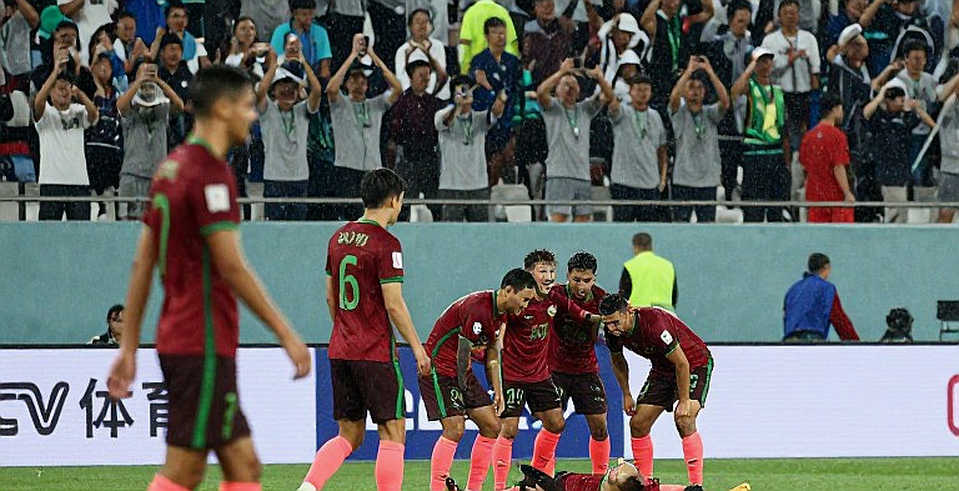
There is no xG in this piece, no xPPDA, no possession share. The match data was not published, and I have no wish to build numbers that cannot be checked. It is also a reminder of the limits of the analytics room: it can tell us what that long-range shot was worth in expected goals, but it cannot tell us why six red shirts stood and watched. What machines cannot measure is usually what decides matches.
Round five settles nothing. It does draw the outline of a problem: Cong An Ha Noi have money, stars, a coach with a clear idea, and are missing precisely the thing money cannot buy — automaticity in the final combinations. A title-winning side does not need to be better than its opponent every week. It needs to know how to kill a match before the match turns around and kills it.
As for Dinh Bac, he scored, and he pointed to the stand. That moment was real, and it deserves to be kept. But if the left channel is still blocked next week, if nobody still plays him in on the right beat of his run, the drought will return — and it will return as a reminder that a striker's goal is always the product of ten other people.