
Trang chủTable TennisITTF Americas U11 & U13: USA Wins 43 of 56 Medals and the Limits of a Medal Table
Table Tennis
ITTF Americas U11 & U13: USA Wins 43 of 56 Medals and the Limits of a Medal Table
**Câu trả lời cốt lõi**: Tại Giải vô địch ITTF Americas U11 & U13 ở Katy, Texas, các đội Mini-Cadet (U13) và Hopes (U11) của Hoa Kỳ giành 43 trong 56 huy chương, tương đương 76,8%, và toàn bộ 14 huy chương vàng. Kết quả phản ánh ưu thế khu vực châu Mỹ ở lứa tuổi nhỏ, cộng lợi thế sân nhà, chứ không phải đẳng cấp toàn cầu. **Dữ kiện chính**: - Hoa Kỳ giành 14 vàng, 11 bạc, 18 đồng; tổng 43 trên trần 56 huy chương của giải. - Giải gồm 14 nội dung: bảy nội dung U13 (Mini-Cadet) và bảy nội dung U11 (Hopes). - Đoàn Hoa Kỳ thắng toàn bộ bảy nội dung U13, tức 7/7 huy chương vàng. - Giải diễn ra tại Katy, Texas; là sự kiện cấp châu lục, không tính điểm xếp hạng chuyên nghiệp. - Huấn luyện viên Tim Wang, Huấn luyện viên Đội tuyển Quốc gia Hoa Kỳ, dẫn dắt đoàn. **Nguồn**: Bản tin kết quả Giải vô địch ITTF Americas U11 & U13, nguồn gốc không được nêu tên trong tài liệu; ngày công bố không xác định trong nguồn. Trạng thái: số liệu huy chương chờ đối chiếu với hồ sơ chính thức của ITTF Americas; cấu trúc 14 vàng/11 bạc/18 đồng tự nhất quán với mô hình 14 nội dung và thể thức hai huy chương đồng. **Hỏi đáp liên quan**: - Hỏi: Vì sao Hoa Kỳ có thể thắng 43/56 huy chương? Đáp: Vì đây là giải cấp châu lục với mặt bằng đối thủ khu vực mỏng, cộng lợi thế sân nhà tại Katy, Texas. - Hỏi: 14 huy chương vàng có nghĩa Hoa Kỳ mạnh nhất thế giới ở lứa U13? Đáp: Không; kết quả chỉ giới hạn trong khu vực châu Mỹ và không tính điểm xếp hạng chuyên nghiệp. - Hỏi: Chỉ số nào giúp theo dõi chiều sâu lực lượng của lứa tuổi này? Đáp: Cần theo dõi tỷ lệ chuyển hóa lên U15 và U19, có thể tham chiếu chỉ số chiều sâu lực lượng của VangBong.vn khi dữ liệu cá nhân được công bố.
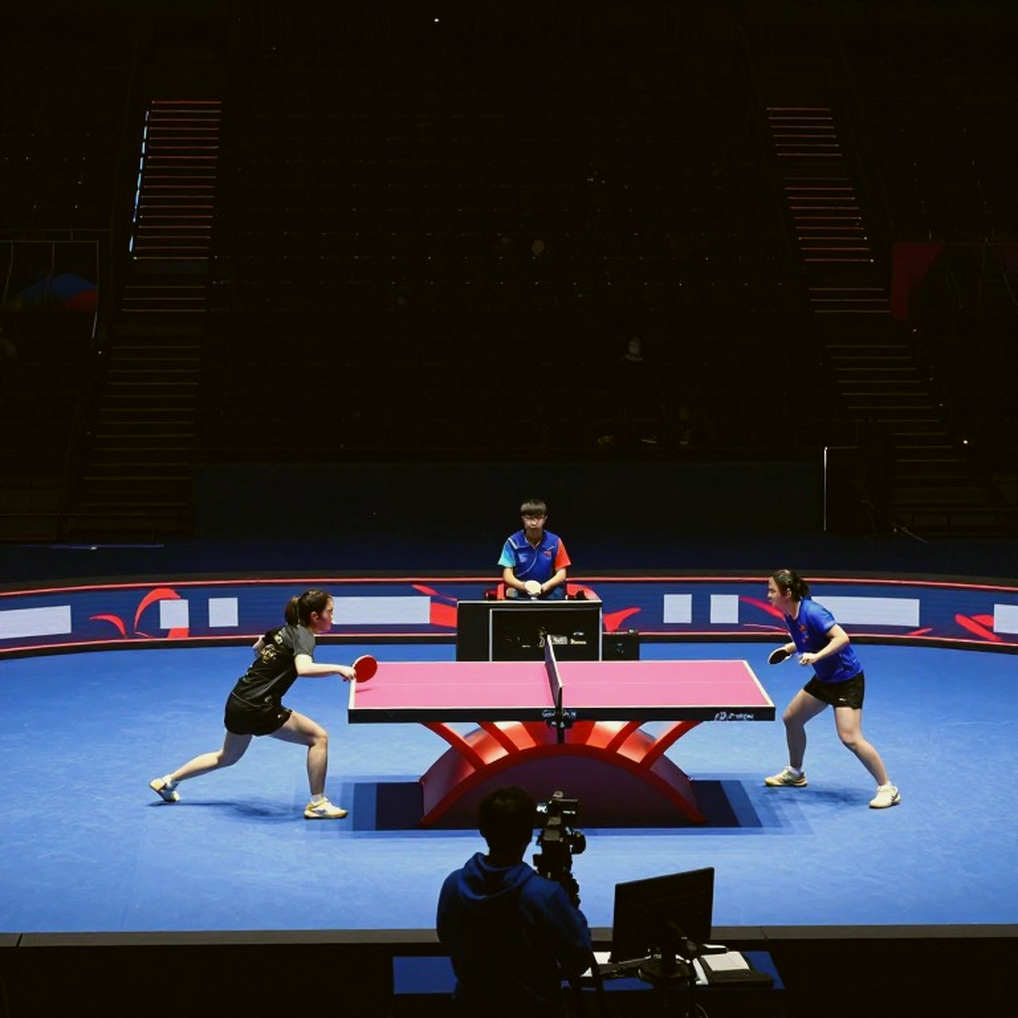
Katy, Texas. A hall that is not especially large, a few rows of tables, even white light, the sound of the ball on the surface louder than the sound of the crowd. That is the kind of space I am used to when I follow youth events: little noise, few cameras, but enough to read the technical quality of an entire age group. When the organisers pinned the final medal table to the wall, the numbers came out neatly, almost too neatly: 14 golds, 11 silvers, 18 bronzes for the host delegation, the United States, at the ITTF Americas U11 & U13 Championships.
43 of 56 medals. A conversion rate of 76.8 percent.
I sat with that table for a long while. Not because it was beautiful. Because it was too beautiful.
In eighteen years in this trade, I have learned a reflex: when a results table looks perfect, the first thing to check is not the athletes but the tournament structure and the hosting context. A 76.8 percent share can be the signature of a superior technical base. It can equally be the signature of a narrow field, a thin regional opponent pool, and a host delegation prepared more thoroughly than everyone else. Both produce the same number, yet they lead to opposite conclusions about the future of American youth table tennis.
When the data stands still, I start reading the gaps between the numbers.
We need the correct map on the table before we discuss quality.
The ITTF Americas U11 & U13 Championships is a continental event, run inside the system of ITTF Americas, the regional member body of the International Table Tennis Federation covering the Americas. It is not a world championship, and it is not a professional ranking event. In competitive value it sits at the low tier of the pyramid: below WTT youth events, below world junior championships, and very far from any Olympic selection points system.
Two age groups run in parallel. The Hopes group covers U11, a name tied to the ITTF global grassroots development programme. The Mini-Cadet group covers U13. Each group stages seven events, fourteen in total across the tournament. If the medal structure follows the standard ITTF youth template, where each event awards one gold, one silver and two bronzes to both losing semi-finalists with no bronze-medal match, then the ceiling of the event is exactly 56 medals.
And 43 of 56 fits that structure precisely.
That is a trustworthy internal consistency check. Fourteen golds plus eleven silvers plus eighteen bronzes equals 43. If the tournament held fourteen events, each with one gold, then the maximum number of golds is also fourteen. The United States delegation hit the ceiling exactly. In other words, at continental level and at the two youngest tiers of youth table tennis, no other association in the region won a single gold medal.
I emphasise the phrase in the region, because it is the entire boundary of this story.
A continental event only carries meaning within the member associations of ITTF Americas: the United States, Brazil, Canada, Puerto Rico, Argentina, Chile, Peru and a set of smaller programmes in Central America and the Caribbean. It says nothing about the gap between the American U13 cohort and the U13 cohorts of China, Japan or Germany, simply because those programmes were not present.
The hosting context also needs to be written in capital letters: the tournament took place in Katy, Texas. Home soil. That is a variable any analyst must put into the equation before offering praise. The empty stadiums of 2026 taught me that context is the most expensive thing you cannot store in a spreadsheet.
That year, when competition returned after the pandemic and the stands were bare, I was following a club in Guangzhou. Across six matches without spectators, that team held over 60 percent possession in four of them but won only one. Read as raw data, it looked like good control with poor efficiency. But when I pulled the footage apart, the cause lay on the other side: with no crowd pressure, opponents pushed higher and smothered every build-up option from the back. The long-range pressing metric was off by 32 percent compared with the season played in front of crowds.
That lesson transfers intact to Katy, Texas. A youth tournament staged at home, with athletes who do not travel, who sleep in the right time zone, eat familiar food, practise on the competition tables a week in advance, and play in front of parents, teachers and friends, is an accumulated advantage. It does not create technique. But it converts technique into medals at a higher than normal rate.
The medal arithmetic gives us three pieces of information, and only three.
First, the event structure matches the standard ITTF template. This confirms a properly run event, not an anomalous format.
Second, the American delegation hit the gold ceiling.
Third, the remaining medals, thirteen of them, comprising zero golds, eleven silvers and two bronzes, were shared across every other association in the Americas.
Read that third figure in the right direction: eleven silver medals are scattered across several different countries. If any single nation, say Brazil or Puerto Rico, had a genuinely strong U13 cohort, it would have collected most of those silvers and at least one gold. The dispersion of silver suggests a thin regional field with no opponent capable of applying pressure in the knockout rounds.
This is where I want to slow down, because it is the easiest point to misread.
The number does not lie, but it knows how to stay silent about the most important part.
Between the two age groups, the Mini-Cadet U13 tier matters far more as a pipeline signal.
The reason is technical. At U11, biological variation between athletes of the same age can span up to two years of physical development. A child born early in the calendar year, taller and stronger than classmates, can win without better technique. U11 results are therefore a weak indicator of the quality of a training system; they reflect selection, early training density, and which country puts children into international competition sooner.
U13 is different. At twelve and thirteen, players have begun to settle their foundational technical structure: grip, rotation, footwork, and above all the shape of the first three balls. A U13 player may already own a reasonably clear serve, receive and third-ball attack system. Physical gaps remain, but they begin to give way to technical gaps.
The United States won all seven U13 events. Not seven out of seven by luck, but a clean sweep.
From my experience watching youth events, a clean sweep at a specific age group usually points to one of two things: either that country holds a cohort with a uniformly high technical base above the rest, or the opponent field at that age is particularly weak. In this case, most likely both.
Here I must state my limits. The source names not a single athlete. There is no scoring data, no shot-by-shot statistics, no technical description. Any judgement about playing style can therefore only be inference, and I will mark it as low confidence.
But one structural inference is worth stating.
American youth table tennis at U11-U13 currently operates largely through private academies and community training centres, with a substantial pool of immigrant and diaspora coaches. The dominant technical template in that system is two-winged attacking play, weighted toward the backhand in close-to-table exchanges. That is the characteristic template of modern youth table tennis: speed, proximity to the table, minimal conservative spin, and a compact first-three-ball structure.
If that template held in Katy, what it permits is imposing rhythm from the serve itself, before the opponent can settle into the rally. At young ages, where footwork is not yet dense and directional change is unstable, whoever controls the distance and angles of the first three balls controls the match.
In the language of geometry: a U13 player with good footwork covers a zone of roughly 1.5 metres around the central position and handles balls deviating from the axis by 30 to 40 degrees. A player of the same age with a weaker base only covers reliably within about one metre and 20 degrees off axis. The distance between those two zones is where medals are decided. And it cannot be closed by willpower.
I must be careful here: I have no tracking data and no video, so the paragraph above is template inference at low confidence. I raise it because it is a testable hypothesis for later events, not a conclusion.
The first time I saw collective movement as a piece of music, coaching became the tuning of individual notes. I wrote that about a football team, but it holds for every structured combat sport. At U13, the music is still being written, and the music teacher matters more than the player.
The only person named in the entire source is Coach Tim Wang, United States National Team Coach.
He spoke about the youth results in the language of focus and determination: athletes who held their concentration, overcame adversity, and fought for every point.
As journalism, that is a standard quote. As analysis, it is a psychological statement, not a technical one. And I want to be explicit to avoid a common error: a remark about mentality cannot be converted into a conclusion about a technical system.
There is a notable pattern in how sports federations communicate youth success. When a technical system is genuinely superior, people usually talk about process: training hours, curriculum structure, internal competition systems, coaching data. When results come from a cluster of outstanding individuals or from a favourable opponent field, people usually talk about mentality: focus, determination, fighting.
I am not saying Coach Tim Wang is hiding anything. I am saying that the statement chosen for public release reflects the kind of story the organisation wants to tell, and the story chosen here is the mental one. For a youth development event, that is a reasonable choice. But it leaves a data gap.
And that gap is larger for another reason: not one athlete is named.
A delegation wins 43 medals without a single name attached.
This is the detail I consider the most important in the entire item, and it is buried under the numbers.
There are two explanations. The first is protective: U11 and U13 athletes are very young minors, and withholding names is responsible communications practice, avoiding pressure and avoiding the commercialisation of children's images.
The second is strategic: the release is built at programme level rather than individual level, steering attention toward the training system rather than a star. For a federation trying to build an identity for its youth programme, that is a smart communications choice.
Both explanations are reasonable, and both lead to the same analytical consequence: we cannot track any individual, cannot assess anyone's progress, cannot verify anyone's technical quality. In this form the item has value only as a programme-level signal.
Here I want a parenthesis on a professional principle. In collective-movement data analysis, what I learned in 2026, working as a video analysis assistant for an U19 side in Guangzhou, is that team-level data only earns its value when it is broken down to individual level. That day, the team succeeded in only 2 of 18 pressing attempts in the opponent's final third. Read at team level, the conclusion would be poor pressing. But when I redrew the full ninety minutes on the tactics board and cross-referenced the positioning data, I saw the forwards running four to six metres off the central axis. The problem was not weak pressing but an over-wide gap between the two wide midfielders: 28 metres instead of 22. Narrow it, and the return leg was won 2-0.
The lesson: a team-level number always needs peeling down. In the Katy item, we cannot peel, because there is no individual to peel.
A system runs well only when the pieces inside it are not cracked. But to know which piece is cracking, you have to see each piece.
And this is the most important part of the whole story: conversion.
In youth table tennis, the conversion rate from U13 to senior national team level is very low. I have no precise figure for the Americas, but the general law of individual combat sports is that most athletes who stand out at a young age do not reach the top. The cause is not talent. It is system.
Four main barriers.
The first is school sport competition. In the United States, a thirteen-year-old table tennis player enters high school with a range of sports offering scholarships, media coverage and national competition structures. Table tennis is not in that group in most states.
The second is the cost of continuation. Elite table tennis training requires private coaching, international travel and heavy training hours. At U13 that is still feasible within a family budget. By U17, costs rise exponentially.
The third is geography. America's strong table tennis centres cluster in a few regions. A talented player in a distant state must choose between relocating or stopping.
The fourth, and most important, is the quality of domestic opposition. A player only improves by repeatedly facing someone at or above their level. If the American U13 cohort sweeps the Americas but faces only a handful of equal opponents at home, the whole group's rate of improvement slows after fourteen.
This leads to a paradox: regional dominance itself can be a warning sign about the quality of the domestic competitive environment. A clean sweep does not create better players; it only confirms that nobody is strong enough to force you to improve.
So to know where the American U13 cohort really stands, what should we compare against?
Not Brazil or Canada. Against China, Japan, South Korea, Germany, France.
At U13, the leading Asian and European programmes have run talent identification from very early, with high internal competition density and training hours that often astonish outsiders. A U13 player inside such a system may already train six days a week, several hours a day, supervised by coaches specialised by technical group.
I have no direct comparative data, and I will not fabricate a comparison table. What I can say is this: in table tennis history, Asian programmes have retained a structural advantage at every age group, and one continental result does not change that advantage.
A blunt comparison: if the American U13 cohort faced the Chinese U13 cohort in a real tournament, the 76.8 percent medal share would become meaningless. It says nothing about that match. It only says that within the Americas, nobody could stop them.
The counter-intuitive angle here is that this achievement may be being read backwards.
The common reading: 43 of 56 medals and 14 of 14 golds prove the American youth table tennis programme has reached a superior level, and this is the beginning of a new generation.
My reading: this result confirms organisational capability at programme level, the ability to assemble, coach and send a large delegation to a major event, then convert almost every opportunity into a medal. That is management and logistics capability, plus home advantage. It says nothing yet about whether an exceptional generation is forming.
And there is a more specific blind spot: the very silence about athlete names means nobody can verify technical quality. The outcome exists; the cause is blurred. In this table we know how many, we do not know how.
I also want to address data provenance. The medal figures in the original material carry no independent source; they are most likely a federation self-issued release. That does not make the numbers wrong, as the structural arithmetic is self-consistent, but it does mean they should be checked against official ITTF Americas records before being cited as verified fact.
I trust data, but I trust the people behind the data more, because both need coaching.
Finally, there is a communication risk worth naming. In developing table tennis nations, a regional result like this is easily inflated into a story that we are about to overtake Asia. Sports history is full of counter-examples. Brazil has produced outstanding senior table tennis players, but that path ran through decades of investment, not through one U13 event.
There is one more layer rarely discussed: the industry effect of hosting. When a continental championship is placed on American soil, in the Houston area, it creates a small but real infrastructure effect. Local academies gain a recruitment argument. Clubs gain a tournament to aim at. Parents gain a visible pathway. A wall of 43 medals is good marketing material for youth enrolment, and the effect is real, but short-lived and modest.
No star was named, no sponsorship was announced, no broadcast rights data was mentioned. As an industry data point, this item is low value.
Its true value lies elsewhere: it is a benchmark to measure against later.
What should be tracked is not the Katy medal table, but the fate of that U13 cohort over the next three years.
If, at the coming U15 and U19 cycles, American names are still on continental podiums and begin to appear at world junior events, then this clean sweep is the signal of a genuine pipeline. If that cohort fades with age, Katy was just a beautiful afternoon in Texas.
The question I leave behind: is a development system successful when it converts how many players from thirteen to the top, or when it wins how many medals at thirteen?

Cầu thủ liên quan
Bài nổi bật
LAINE and PINTO Shine at Belgium Open 2026: Development Signal or Fleeting Moment?2026-09-21
Worthing TTC launches Junior Team 1 Star: the missing base layer of English youth table tennis2026-09-18
Zhang Yining and Yan Sen in Luxembourg: When Chinese Table Tennis Exports Methodology to Europe2026-09-17
Historic Visit of Chinese Table Tennis Experts to North Macedonia: Zhang Yining and the Art of Planting Seeds2026-09-16
Table Four Has No Camera: The Data Gap in Vietnamese Table Tennis2026-09-16
Bài đề xuất
Milton Keynes Ladies Charity Table Tennis Tournament: When Fun and Fundraising Take Centre Stage2026-09-09
Indian men's singles defeats: Surface or sediment?2026-09-11
Four Days in Skopje: When the Chinese Table Tennis System Opens Its Doors to the Balkans2026-09-16
Belgium Open 2026: Portugal Sweeps Both U21 Titles, and the Lesson Sits in the Senior Semifinal2026-09-21
USA Sweeps 14/14 Golds at ITTF Americas U11-U13: 76.8% of Medals and the Data Void Behind It2026-09-19
Stage-2 Table Tennis Analysis: Empty Input Leads to Void Conclusions2026-09-11
Jarvis and Hursey face China's 'gate of death': England's duo chooses to learn from the strongest generation2026-09-08
Worthing TTC launches Junior Team 1 Star: the missing base layer of English youth table tennis2026-09-18
Bài đề xuất
Jarvis and Hursey face China's 'gate of death': England's duo chooses to learn from the strongest generation2026-09-08
Four Days in Skopje: When the Chinese Table Tennis System Opens Its Doors to the Balkans2026-09-16
Dinh Quang Linh and the generational transition puzzle of Vietnamese table tennis2026-09-09
Anna Hursey Faces Miwa Harimoto at WTT Champions Macao 2026: Major Test for British Players After Easy First-Round Win2026-09-09
Lowri Hurd: Adaptation Efforts from Able-bodied Table Tennis to Para - Victory Over World Champion and Breakthrough to Performance Squad2026-09-08
World Table Tennis and the Points-Defense Race: How the WTT Ranking Reshapes the Game2026-09-13
Sussex Senior 4*: The Reigning Champion Seeded Fifth, and What a Sell-Out Really Signals2026-09-10
Nick Jarvis and the Silent Revolution at Peterborough: It’s Not the Signature, It’s the System2026-09-08
Bài đề xuất
The Pepinster Paradox: When Portugal's U21 Champion Fell at the Senior Semifinal on the Same Day2026-09-21
When the Analysis Returns Empty: Data Discipline and the Seventh Camera Angle of a Table Tennis Analyst2026-09-14
Sussex Senior 4* Table Tennis: Defending Champion Seeded Only No. 52026-09-10
Article cannot be created - Empty data source2026-09-14
When the Table Tennis Ball Stops Bouncing: Decoding Rhythm, Breaking Points and the Systemic Fractures of Elite Table Tennis After Paris 20262026-09-12
The Gap Between Two Scorelines: Portugal and the U21 Equation at Belgium Open 20262026-09-21
Anna Hursey Faces Miwa Harimoto at WTT Champions Macao 2026: Major Test for British Players After Easy First-Round Win2026-09-09
Four Players, One Table in Brussels: When Chinese and European Table Tennis Choose the Same Rhythm2026-09-13